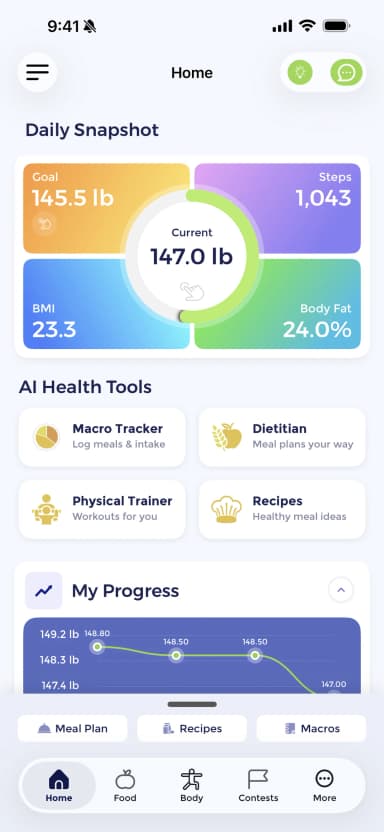
 Powered by Vygor — get the free app for full meal plans & tracking
BMR (Basal Metabolic Rate) is the calories your body burns at rest, just to keep you alive. TDEE (Total Daily Energy Expenditure) adds your activity level on top of that — it's your maintenance calorie level.
Your weight, projected with a dynamic model — not a straight line, since your calorie needs drop as you lose weight.
Vygor turns your calorie target into daily meal plans, recipes, workouts and progress tracking — free to download.

The timeline chart uses a simplified dynamic energy-balance model, similar in spirit to the NIH Body Weight Planner: as you lose weight your BMR and TDEE drop too, so a fixed calorie target produces a shrinking deficit over time, which is why loss decelerates instead of following a straight line. It doesn't capture everything — metabolic adaptation beyond body-weight change, water-weight swings, or shifts in muscle vs. fat — so treat the curve and date as a rough guide, not a guarantee. Recalculating your target every 10–15 lb (5–7 kg) lost will keep the plan accurate as your body changes.
Estimates only, based on the Mifflin-St Jeor equation and a standard energy-balance model (~3,500 kcal per lb / ~7,700 kcal per kg of body fat). Actual results vary by individual. This is not medical advice — consult a healthcare provider before starting any weight-loss plan, especially if your calculated calorie target is at or near the safety floor shown above.